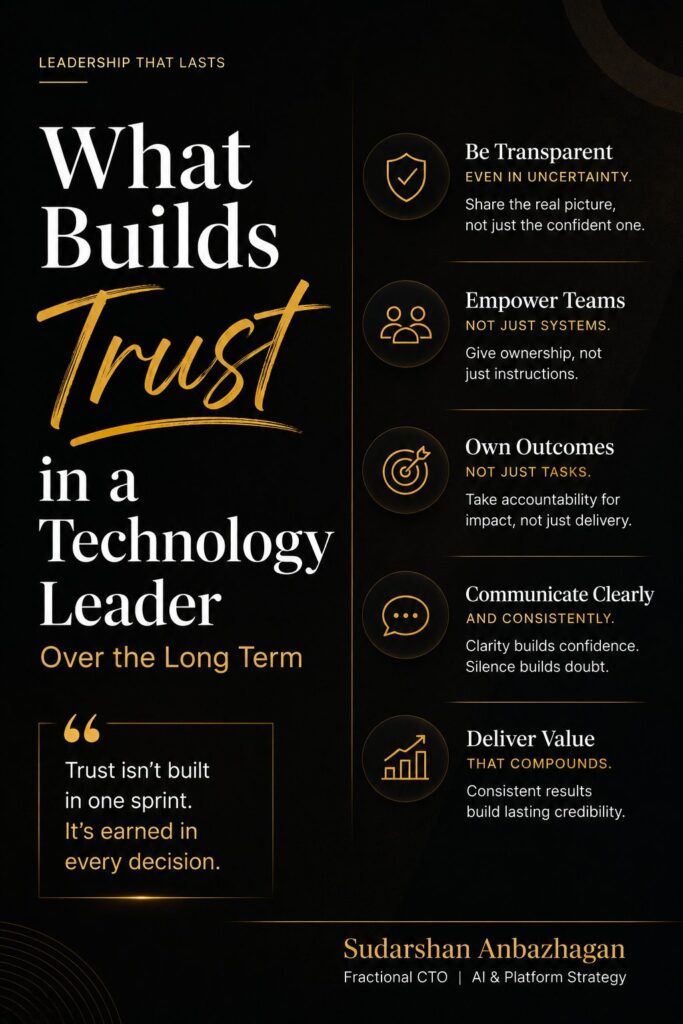

Trust in a technology leader is one of the most consequential variables in the performance of any organisation that depends on technology to compete, grow, or operate. It is also one of the least systematically understood. Most organisations evaluate their technology leaders on a combination of technical depth, delivery track record, and strategic alignment. These are legitimate and important criteria. But they are not what determines whether a technology leader earns the sustained, expansive trust that allows them to drive genuinely transformational outcomes over a period of years. That kind of trust is built through a different set of behaviours, and it is built slowly, through an accumulation of moments that individually may seem unremarkable but collectively define the leader’s credibility in the minds of the people who depend on them most.
I have been working as a technology leader across fourteen countries for fifteen years, in roles that ranged from hands-on CTO to Fractional CTO engagements with organisations at very different stages of maturity and in very different operating contexts. The most consistent finding across all of that experience is that the technology leaders who earn lasting trust are not the ones who always have the right answer. They are the ones who never pretend to. That distinction sounds simple. In practice, it requires a discipline that runs counter to many of the professional incentives that shape how technology leaders present themselves, particularly in environments where confidence is often mistaken for competence and certainty is rewarded over honesty. Understanding why that distinction matters, and what it looks like in practice across five specific leadership behaviours, is what this piece is about.
This is written for C-suite executives who work alongside technology leaders, for technology leaders who are building their own credibility in complex organisations, and for anyone who has ever wondered why some technology relationships produce exceptional outcomes over the long term while others stall, erode, or collapse despite strong individual capability on both sides. The answer is almost always about trust, and trust is almost always about the five qualities described here.
Why Expertise Gets You the Seat but Trust Keeps You There
The first thing worth establishing is why technical expertise, while necessary, is not sufficient to build the kind of trust that enables long-term technology leadership effectiveness. Expertise earns the initial credibility that opens the door. It establishes that the leader has the knowledge to be taken seriously on technical matters and the experience to understand the implications of technology decisions in a business context. Without it, no amount of interpersonal skill or communication ability will compensate for the gap when a technically demanding decision needs to be made and the organisation is looking for someone they can follow with confidence.
But expertise has a ceiling as a trust-building mechanism, and that ceiling is reached earlier than most technology leaders expect. Once a leader has demonstrated sufficient technical depth to earn the organisation’s confidence in their judgment, additional technical credibility produces diminishing returns on trust. What the organisation is evaluating at that point is something different: whether this leader will tell them the truth when the truth is inconvenient, whether they will own difficult outcomes with the same energy they bring to successful ones, whether the commitments they make will be honoured consistently, and whether they will communicate clearly and proactively even when the news is not what the audience wants to hear. These are not technical competencies. They are human ones, and they are the competencies that separate the technology leaders who accumulate deep institutional trust over years from the ones whose credibility erodes despite strong technical performance.
The practical implication for both technology leaders and the executives who work with them is that the evaluation framework for technology leadership needs to include these human qualities explicitly, not as a soft addendum to the technical assessment but as a primary criterion for determining whether a leader is performing at the level the organisation needs. The most capable technologist in the room who cannot be fully trusted to communicate honestly, own outcomes completely, and deliver consistently is a liability in a role that requires high-stakes decisions to be made on the basis of their input and their judgment.
Transparency in Uncertainty: The Quality That Separates Great Leaders
Of all the qualities that build lasting trust in technology leadership, transparency under uncertainty is the one that is most consistently present in the leaders whose credibility endures and most consistently absent in the leaders whose credibility eventually fails. This is because uncertainty is the constant operating condition of technology leadership. The technology landscape changes faster than any individual or organisation can fully track. Projects reveal complexity that was not apparent during planning. Decisions made with the best available information turn out to have been based on assumptions that were reasonable at the time but proved incorrect as implementation progressed. Any technology leader who is operating honestly will be in a state of partial uncertainty about significant questions for a meaningful portion of their working time.
The question is not whether uncertainty exists. It is what the leader does with it. The approach that builds trust over the long term is to share the real picture rather than the confident one. This means telling the board that the timeline is at risk before the risk becomes a miss rather than after. It means telling the executive team that you are still working through the implications of a particular architectural decision rather than presenting a false certainty that will unravel when the implications become visible. It means being explicit about what you know, what you are still investigating, and what you are genuinely uncertain about, in a way that gives your organisation the information it needs to make good decisions rather than the reassurance it might prefer to hear in the moment.
The counterintuitive finding from years of observing this behaviour in high-performing technology leaders is that sharing uncertainty does not undermine confidence. Done with the right framing, it builds it. When a technology leader tells a CEO or a board that they do not yet have a complete picture of a particular risk but will have a clearer view within a defined timeframe and here is what they are doing to develop that clarity, the response from most experienced executives is not concern about the leader’s capability. It is appreciation for the honesty and confidence in the leader’s judgment about what matters. It is the leaders who project certainty they do not possess who eventually damage their credibility irreparably, because the moment their certainty is revealed to be performance rather than genuine knowledge, every previous statement of confidence becomes suspect in retrospect.
Empowering Teams: The Difference Between Delegation and Ownership
The second quality that builds lasting trust in technology leadership is the ability to empower teams in a way that produces genuine ownership rather than the execution of instructions. This distinction matters more than it might initially appear, because the two produce fundamentally different organisational outcomes. A team that is executing instructions is dependent on the leader for every significant decision, which limits the leader’s bandwidth, slows the organisation’s responsiveness, and produces people who are technically capable but organisationally passive. A team that genuinely owns its domain makes decisions, surfaces risks, proposes solutions, and drives outcomes in a way that multiplies the leader’s impact rather than consuming it.
The behaviour that distinguishes leaders who build ownership from those who retain it is visible in how they respond when a team member brings them a problem. The instruction-oriented leader provides the answer. The ownership-oriented leader asks the questions that help the team member develop the answer, then holds them accountable for implementing it. Over time, the teams led by ownership-oriented leaders develop a level of capability, confidence, and initiative that makes them significantly more effective than teams of comparable individual talent led by instruction-oriented leaders. The difference is not in the talent. It is in the leadership approach, and the leadership approach is a reflection of whether the leader trusts their team enough to give them real authority and whether they are secure enough in their own contribution to derive satisfaction from enabling others’ success rather than positioning their own.
For C-suite executives evaluating a technology leader’s effectiveness, one of the most reliable indicators of whether they are building genuine team ownership is the quality of the team’s performance when the leader is not in the room. A technology leader who has built a high-ownership team produces a team that performs with the same quality, initiative, and decision-making capability whether the leader is present or absent, because the team has internalised the standards, the context, and the accountability that the leader has instilled. A leader who has retained control rather than distributing ownership produces a team whose performance degrades noticeably when they are not available, because the team has learned to wait for direction rather than to generate it.
Owning Outcomes: The Accountability Behaviour That Defines Leadership Credibility
The third quality is outcome ownership, and it is the one that most clearly separates leaders who earn lasting trust from those who receive it conditionally. Outcome ownership means taking full accountability for the results of technology decisions and technology performance, regardless of whether those results are positive or negative, and regardless of how much of the outcome was within the leader’s direct control. It means that when a project delivers exceptional value, the leader attributes that value to the team and the organisation. When a project falls short of expectations, the leader takes accountability for the miss without distributing the responsibility across contributing factors in a way that reduces their own exposure.
This behaviour is rare because it requires a level of professional security that is genuinely difficult to maintain in high-pressure environments where performance is closely evaluated and significant decisions carry significant consequences. The instinct when something goes wrong is to identify the factors that contributed to the outcome that were outside one’s own control, and to ensure that those factors are visible to the people who are evaluating the outcome. This instinct is understandable, and in many cases the factors identified are real and relevant. The problem is that the consistent pattern of managing accountability exposure erodes trust over time in a way that is difficult to reverse, because the people on the receiving end of these accountability discussions gradually develop the sense that they will never receive a fully honest accounting of what happened and what the leader’s responsibility in it was.
The technology leaders who build the deepest credibility over long careers are the ones who have developed the discipline to own outcomes fully, including the ones where the contributing factors were largely outside their control. This does not mean accepting blame for things that were genuinely not within their sphere of influence. It means taking responsibility for how the organisation navigated those factors, for the quality of the risk assessment that preceded them, for the speed and quality of the response when they materialised, and for the lessons that the organisation draws from the experience. That level of ownership is what makes the people around a technology leader confident that they are getting the full picture, and that confidence is the foundation of the deep trust that allows technology leaders to influence decisions at the highest levels of an organisation.
Communicating Clearly and Consistently: The Discipline That Builds Institutional Confidence
The fourth quality is communication clarity and consistency, and it deserves particular attention because it is one of the areas where technology leaders most frequently underinvest relative to its impact on trust. There is a persistent tendency in technical disciplines to assume that clarity of execution is a sufficient proxy for clarity of communication, that if the work is done well and the results are visible, the communication around the work is relatively unimportant. This assumption is incorrect, and the cost of it shows up most clearly in the gap between what technology leaders believe they have communicated and what their executive colleagues actually understood.
Clarity in technology leadership communication means translating technical reality into business language with the precision and completeness that allows non-technical decision-makers to form accurate mental models of what is happening, why it matters, and what their involvement is required for. It means not assuming that a technically accurate update is also a businessly useful one, because the two are frequently different things. A technically accurate status update might tell the board that the system migration is 73 percent complete and ahead of schedule on all critical path items. A businessly useful update tells them what that means for the February launch commitment, what the remaining risk exposure looks like and how it is being managed, and what decisions, if any, they need to make in the next two weeks. The difference between these two updates is the difference between a leader who is reporting and a leader who is communicating.
Consistency in communication means that the frequency, format, and substance of updates does not vary based on whether the news is positive or negative. One of the most corrosive patterns in technology leadership communication is the leader who provides proactive, detailed updates when performance is strong and becomes harder to reach or less forthcoming when challenges arise. This pattern, even when it is not consciously strategic, communicates to the organisation that transparency is conditional, and conditional transparency is experienced as its absence. The leaders who build lasting communication credibility are the ones who maintain the same discipline of proactive, honest, complete communication regardless of whether the message is comfortable or difficult to deliver.
Delivering Value That Compounds: The Long Game of Technology Leadership
The fifth quality is the one that operates over the longest time horizon and produces the most durable trust. Delivering value that compounds means building a technology contribution that increases in impact over time rather than plateauing at a level of steady-state maintenance. It means making architectural and platform decisions that create optionality for the future rather than solving immediate problems in ways that create constraints later. It means building teams that become more capable year over year rather than remaining at the level they were when the leader arrived. And it means accumulating a track record of consistent delivery against commitments that gives the organisation confidence not just in the leader’s current performance but in their future contribution.
The compounding quality of great technology leadership is most visible in organisations that have retained the same technology leader through multiple periods of significant change, whether that is rapid growth, major platform transitions, market disruptions, or organisational restructuring. In these organisations, the technology function tends to become progressively more capable of navigating change over time, because the leader has invested consistently in the capabilities, the governance frameworks, and the talent development practices that make the organisation resilient rather than merely reactive. The technology portfolio becomes more integrated, more strategic, and more directly connected to business outcomes with each passing year. The team becomes more autonomous, more confident, and more capable of driving innovation without constant leadership direction. And the trust between the technology function and the rest of the executive team deepens progressively, because the consistency of delivery has produced a shared history that both sides can draw on when new challenges arise.
This is the long game of technology leadership, and it is the game that produces the most significant outcomes for the organisations that play it. It requires patience from leaders who are accustomed to being evaluated on short-term delivery metrics. It requires investment in capabilities that will not produce visible returns for quarters or years. And it requires the kind of sustained relationship between technology and business leadership that only develops when both sides have committed to building something together rather than managing the interface between two separate functions.
Trust Is Earned in Every Decision, Not Announced in Any One Moment
The central insight from fifteen years of technology leadership across fourteen countries and hundreds of engagements is that trust is not an outcome that can be engineered through a single impressive moment or a well-managed crisis response. It is an accumulation of thousands of smaller moments, each of which either adds to or subtracts from the reserve of credibility that a technology leader carries into every significant interaction. The moments that add most consistently are the ones where the leader chose honesty over comfort, ownership over deflection, clarity over impression management, and a long-term investment in team capability over a short-term demonstration of personal capability.
The most trusted technology leaders I have observed and worked alongside over the course of my career share a characteristic that is easy to describe and genuinely difficult to practise: they make the people around them feel more confident about making important decisions, not because they eliminate uncertainty but because they are honest about it, not because they take every problem off the table but because they ensure the table always has the right people and the right information at it. That quality of presence, that reliability of judgment and honesty and ownership, is what organisations are actually looking for when they describe a technology leader as someone they trust completely. It is available to any leader who chooses to develop it, and the investment in developing it returns more than any other investment a technology leader can make in their own effectiveness.
If this perspective on technology leadership trust resonates with challenges or opportunities you are navigating in your own organisation, I welcome the conversation. You can connect with me directly at linkedin.com/in/sudarshananbazhagan. The most valuable leadership conversations I have had began with a single honest question about what trust actually looks like in a specific context, and I am always glad to explore that question with leaders who are serious about the answer.