
Over 15 years of leading enterprise technology engagements across 14 countries, I have had the privilege of watching integrations transform how organisations operate. The ones that deliver lasting value, the ones that teams are still grateful for three and five years after go-live, share something that has nothing to do with the sophistication of the technology involved. They share the quality of thinking that happened before the build began. The leaders responsible for those integrations made a deliberate choice to slow down at the start, to ask the right business questions, and to let clear answers shape every technical decision that followed. That investment in early clarity is what made everything else faster, more aligned, and more effective.
What I have come to understand deeply is that the outcome of an enterprise integration project is largely decided before a single API is designed or a data map is drawn. The technology choices matter. The vendor selection matters. The build quality matters. But the foundation beneath all of it is the clarity of business thinking in the weeks before the project formally begins. When that thinking is strong, the entire build moves with a confidence and coherence that is genuinely hard to manufacture at a later stage. When it is rushed or assumed rather than established, the most talented build team in the world will spend more effort than they should resolving ambiguities that could have been settled in a conversation.
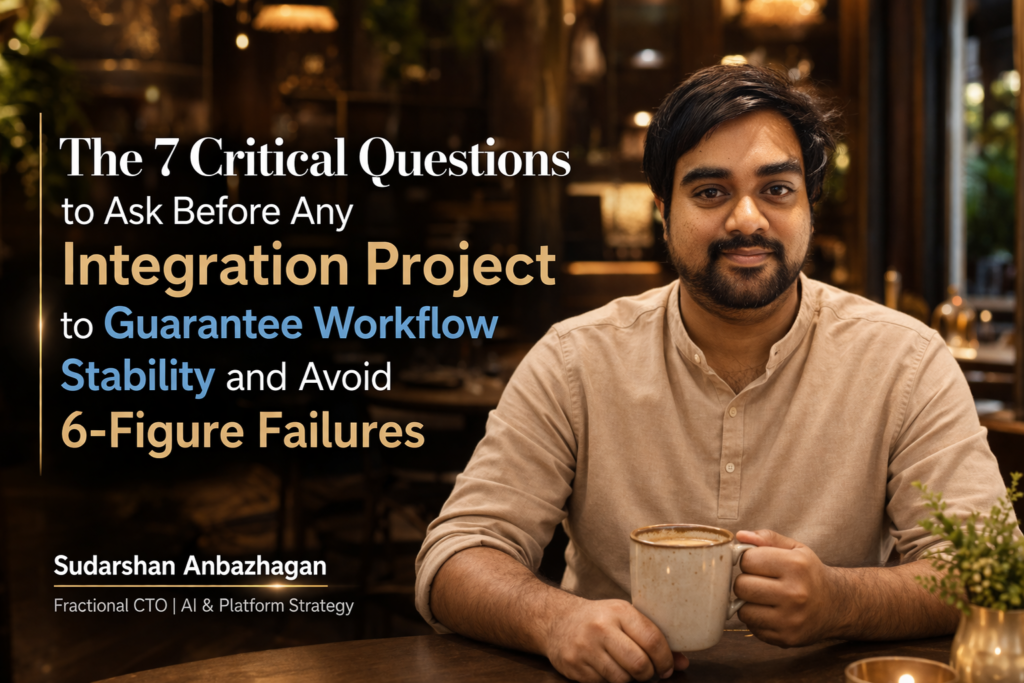
The habit I have seen in the most effective technology leaders across every geography and industry I have worked in is this: they treat the pre-build phase as the highest-leverage phase of any integration project. They invest real thinking time before the work begins. They ask questions that sound almost too fundamental for a senior technology discussion, and they wait for genuinely clear answers. Not technical questions about architecture patterns or middleware selection, but business questions about ownership, workflow, accountability, and outcomes. Seven questions, specifically, that consistently surface everything worth knowing before the build begins.
Why the Thinking Phase Is Where Integration Value Is Created
Most organisations understand integration investment in terms of build effort. Development hours, vendor licensing, infrastructure provisioning, testing cycles, these are the costs that appear in every project budget and that project managers track carefully. What is less visible, and significantly more valuable to get right, is the investment made in the thinking phase before the build begins. This is where the decisions that will shape the integration’s long-term value are most accessible, most flexible, and least expensive to make.
What I have observed consistently across the integrations I have led and overseen is that the projects which deliver the most lasting business value all share one common practice: they establish clear answers to a defined set of business questions before allowing the build to begin. Not broad questions about goals and objectives, which every project addresses in its charter, but specific questions about data ownership, workflow stability, governance structure, end user involvement, automated decision boundaries, recovery planning, and business success definition. Each of those questions, when answered clearly and specifically, produces a better design decision. Together, they produce an integration that the business can rely on and build upon for years.
The organisations where I have seen this discipline practiced most consistently are also the ones where technology has the strongest strategic credibility. Because when integrations deliver what they were designed to deliver, and continue delivering as the business evolves, the relationship between technology leadership and business leadership deepens. Investments get approved more readily. Timelines are trusted. And the conversations that matter most, about how technology can support the next stage of the organisation’s growth, happen at the right level with the right confidence. That credibility is built one well-executed project at a time, and it starts with the quality of thinking before the build begins.
Question One: Who Is Genuinely Accountable for the Data This Integration Touches?
The most grounding question I ask at the start of any integration engagement is this one, and the depth of the answer tells me a great deal about how ready an organisation is to build. Every enterprise system has an owner and every project has a sponsor. What I am looking for when I ask this question is something more specific: the person whose team’s daily work is directly shaped by the quality, accuracy, and timeliness of the data that this integration moves. That person is the most important voice in the design process, and identifying them clearly at the outset sets the entire project on a stronger foundation.
The distinction I draw in this conversation is between system ownership and operational accountability. A system owner manages a platform technically. They control access, maintain configurations, and manage the vendor relationship. The operationally accountable person is the one whose team’s performance is directly connected to the data flowing correctly through the integration every day. This is the finance leader whose reconciliation process depends on transaction data syncing accurately and on time. This is the revenue operations manager whose sales team’s pipeline visibility depends on CRM and ERP data staying aligned. This is the customer success director whose team’s ability to serve clients well depends on having a complete and current view of each account. These people carry the most useful design knowledge of anyone involved in the project, and when they are active participants in scoping, the integration that results reflects operational reality in a way that no technical specification alone can produce.
When I ask this question, I am listening for three specific signals that tell me the organisation has the accountability clarity it needs to build well:
- Whether the accountable person can be named specifically, not just by role or team. An answer like “Revenue Operations owns the customer data” opens the right conversation. An answer that names an individual and describes their accountability concretely tells me the organisation is ready.
- Whether that person is actively shaping requirements, not just reviewing them. There is a meaningful difference between a stakeholder who has been briefed on a project and a stakeholder who has influenced its design. When operationally accountable people are involved in shaping what gets built, the result reflects the workflow as it actually operates, not as it is documented.
- Whether accountability is defined through go-live and beyond. The integrations with the longest stable operating lives are the ones where the accountable person was identified before the build and remained engaged after it. That continuity of ownership is what gives an integration the organisational care it needs to stay aligned with the business over time.
Question Two: Is the Workflow This Integration Will Formalise Genuinely Settled?
An integration is one of the most powerful tools an organisation has for formalising how it operates. When the workflow it encodes is stable and well-understood, the integration becomes a force multiplier, executing a proven process consistently, automatically, and at scale in a way no manual workflow can match. The key word in that statement is stable. The workflows that benefit most from integration are the ones where the fundamental logic of how the process works has been established, agreed upon, and is being executed reliably by the teams involved.
This is a question I ask with genuine curiosity, because the answer is not always what project sponsors expect to hear, and the conversation it opens is often the most valuable one that happens before a build begins. Organisations evolve constantly. Processes that appear settled on paper are sometimes in quiet motion because of recent leadership changes, shifting business priorities, or ongoing discussions between departments about how certain decisions should be handled. None of these situations means an integration should not happen. They simply mean there is foundational work to complete before formalising the process into a system.
What I have found across hundreds of integration engagements is that when this question is asked directly and the answer surfaces a process that is still being refined, the most valuable thing a technology leader can do is create space to complete that refinement before the build begins. The investment in resolving the process question is returned many times over in the clarity and speed of the build that follows. Teams that know exactly what the integration is meant to do make better decisions at every step. The design is more precise, the testing is more focused, and the go-live is more confident because everyone involved is working from the same understanding of what success looks like.
The question I ask is specific: in the past six months, has this process been subject to meaningful internal discussion about how it should work, or are there aspects of it that are still being decided by different teams differently? If the answer surfaces any active ambiguity, that is a valuable finding, not a blocker. It is an opportunity to produce the process clarity that will make everything that follows more effective.
Question Three: What Is the Plan for Smooth Evolution After Go-Live?
Every integration of any real business consequence will need to evolve after it launches. Processes improve. Organisations restructure. Upstream systems release updates that create new possibilities. Downstream teams develop new reporting requirements. The business context at go-live is never the same as the business context twelve months later, and the integrations that serve organisations best over time are the ones that were designed with this evolution in mind.
This is one of my favourite questions to explore in a pre-build conversation because the discussion it opens tends to produce some of the most practical and immediately valuable design decisions in the entire project. When a team thinks clearly about how the integration will need to be maintained and adjusted over time, they make better choices about what should be configurable versus what should be hardcoded, about what level of observability the system needs, about how to structure the codebase for maintainability, and about what kind of documentation will make future adjustments straightforward rather than complex.
The integrations that age best are the ones built with operational flexibility as an explicit design value. The teams that build them think not only about what the integration needs to do on day one, but about how it will be operated, adjusted, and extended by the people who will own it after the build team moves on. That thinking produces systems that are genuinely easier to work with over time. Configuration changes that would otherwise require a development cycle can be handled operationally. Alerting and monitoring built into the system surface issues early, before they affect the business. Documentation that was written for the people who will maintain the system, not just the people who built it, makes every future adjustment faster and less risky.
When I ask what the plan is for smooth post-launch evolution, I am looking for an answer that reflects this kind of forward thinking. An organisation that has considered who will own the integration after go-live, how changes will be requested and prioritised, and what processes will keep the system aligned with the business as it evolves, has already made a significant investment in the long-term success of the project.
Question Four: Have the People Who Will Work With This Integration Every Day Helped Shape It?
Across every geography and industry I have worked in, the integrations that earn the deepest operational trust are the ones where the people closest to the daily workflow were involved in designing the system that would support it. This is not a question of consensus management or broad stakeholder consultation. It is a question of accessing the most valuable and specific knowledge available to the project, which is the lived experience of the people who will interact with this integration as part of their daily work.
End users of enterprise integrations carry operational knowledge that does not appear in requirements documents or process maps. They know which edge cases the current workflow handles through informal steps that were never formally documented. They know the timing dependencies between their team’s work cycle and the data refresh schedules of connected systems. They know which fields are theoretically consistent in the source system but are treated differently by different teams in practice. They know the difference between what the process says and what experienced operators actually do, and they know why. That knowledge is exactly what the design process needs to produce an integration that works operationally and not just technically.
The right approach is not to make every design decision subject to broad approval. It is to identify the two or three people with the deepest operational knowledge of the workflow being integrated, bring them into structured design conversations early, and treat their input as a primary source of design requirements alongside the technical specification. Their involvement tends to surface the considerations that matter most in the time when it costs the least to address them. And their ownership of the resulting system, because they helped shape it, tends to produce stronger adoption and more effective day-to-day use than systems that were designed without them.
Question Five: Where Does This Integration Make Decisions on Behalf of the Business?
Every integration contains logic that does more than move data from one system to another. At certain points in every workflow, the integration evaluates a condition and takes an action based on the result. Some of those actions are straightforward and their automation is clearly appropriate. A nightly sync that updates contact information across platforms based on a designated source of truth is a simple and well-bounded automated action. Other points in an integration’s logic are more consequential: routing logic that determines which team handles a customer issue, threshold logic that triggers a pricing adjustment, status logic that advances a contract through an approval workflow, propagation logic that updates records across multiple systems based on a single upstream event. These are the points where the integration is, in effect, acting as a decision-maker on behalf of the business.
Identifying these points clearly before the build begins is one of the most practical contributions a technology leader can make to the long-term reliability of an integration. When the embedded decision logic is mapped explicitly, the design process can treat each decision point with the attention it deserves. The business consequence of each decision being made correctly can be understood. The exception path for cases where the condition does not cleanly resolve can be designed thoughtfully rather than discovered after go-live. And the level of oversight, alerting, and human review capability appropriate for each decision point can be built into the system from the start rather than retrofitted later.
The conversation I have around this question in pre-build planning covers three dimensions for each decision point the team identifies:
- The business consequence of a correct versus incorrect decision. This determines the risk level of the automated logic and informs how much alerting, exception handling, and override capability the design should include.
- The current human decision process. Understanding how an experienced operator makes this decision manually often reveals important nuance that a technical specification may simplify into a binary condition but that the integration needs to handle with more sophistication.
- The exception path for ambiguous cases. Well-designed integrations route cases that do not cleanly resolve to a human reviewer. This is not a limitation of the integration. It is a feature that reflects a mature understanding of where automation serves the business and where human judgment adds irreplaceable value.
Question Six: What Governance Structure Will Own This Integration After the Build Is Complete?
An enterprise integration is a living system. It is not a project deliverable that is handed over and retired. It is a system with a lifespan measured in years, during which the business it supports will evolve, the systems it connects will be updated and extended, and the teams it serves will develop new operational requirements. The question of who owns the integration’s ongoing operation, maintenance, and evolution, and how they are empowered to manage it, is one of the most consequential questions to answer before go-live.
In my experience, the integrations with the longest stable operating lives are the ones where governance was established clearly before the build team transitioned out. There is a named owner with a clear mandate. There is a defined process for requesting and approving changes. There is a monitoring protocol that keeps the right people informed when the system’s behaviour needs attention. And there is a regular review cadence that keeps the integration aligned with the current state of the business processes it supports. These elements do not need to be elaborate. They need to be clear, agreed upon, and in place before operational ownership transfers.
A practical governance model that I recommend establishing before every enterprise integration go-live includes the following components:
- A named governance owner with clear mandate and organisational access to make operational and evolutionary decisions about the integration.
- A defined change request process that specifies how changes are initiated, evaluated, prioritised, and approved, with clear authority levels for different categories of change.
- A monitoring and alerting protocol that defines what the system monitors, what thresholds generate an alert, who receives it, and what the expected response time is.
- A regular review cadence, typically quarterly for stable integrations, at which performance, business alignment, and upcoming dependency changes are evaluated and addressed proactively.
- A documented escalation path for situations that require vendor engagement or decisions that exceed the governance owner’s authority.
Establishing these elements before go-live costs very little in time or resource. The return on that investment, in smoother post-launch operations, faster response to change, and an integration that stays aligned with the business over time, is consistently significant. The organisations that build this governance structure into their go-live plan are the ones whose integrations are still serving them well years later.
Question Seven: What Does Business Success Look Like at 90 Days?
I always end a pre-build conversation with this question, and the quality of the answer tells me more about the project’s readiness than any other single indicator. It is the question that separates projects that will deliver technical delivery from projects that will deliver business value, and it is the question that gives a technology team the clearest possible target to build toward.
Technical success measures are necessary and important. Systems are connected. Data flows according to specification. Tests pass. Go-live is on time. These are legitimate delivery standards and they reflect the quality of the build. Business success is what happens after the build team has moved on and the integration is operating as the foundation of real work done by real teams. Business success is the finance team closing their month-end reconciliation in two days instead of five because the manual data extraction and re-entry that consumed most of that time is now handled automatically. It is the sales operations team having a complete and current view of every customer account from a single screen rather than switching between three systems for pre-call preparation. It is the support team resolving customer issues faster because the integration gives them order status, billing history, and open tickets in a single view. These outcomes are measurable, meaningful to the people they affect, and give the entire project team a shared and energising target.
When I receive a clear and specific answer to this question, I know the organisation has done the quality of thinking that produces exceptional integrations. That clarity shapes better design decisions throughout the build, produces more useful testing scenarios, and creates the conditions for a go-live that the business experiences as genuinely transformative rather than merely functional. The most powerful thing a technology leader can do for an integration project is to define what business success looks like at 90 days with enough specificity that everyone involved knows exactly what they are building toward.
The Multiplying Effect of Clarity Before the Build Begins
After 15 years and 500+ projects across 14 countries, I am more convinced of this than almost anything else in enterprise technology: the quality of thinking invested before a build begins determines the quality of everything that follows. This is not a theoretical observation. It is a pattern I have seen hold consistently across industries, geographies, organisation sizes, and technology stacks. The integrations I am proudest of, the ones that still form the operational backbone of the organisations they were built for years after delivery, all began with the same investment in answering these seven questions with genuine clarity.
When data ownership is named and the accountable people are engaged as design partners, the build reflects operational reality rather than documented assumptions. When workflow stability is confirmed before formalisation, the integration encodes a settled and reliable process rather than one that is still finding its shape. When post-launch evolution is planned from the start, the system is built for the full span of its useful life, not just for the day it launches. When end users have shaped the design, the system earns operational trust from the teams whose daily work it supports. When automated decision logic is mapped and governed deliberately, the integration operates with the kind of reliability that builds organisational confidence over time. When governance is established before go-live, the system evolves with the business rather than requiring periodic rescue. And when the 90-day business success picture is defined clearly from the start, every member of the build team, technology and business alike, is working toward the same outcome.
The organisations that bring this discipline to their integration projects do something more valuable than producing well-executed deliverables. They build the kind of relationship between technology and business leadership where ambitious initiatives get the investment and support they deserve because the track record of delivery is one the entire organisation can trust. They create an environment where technology is genuinely strategic because it consistently delivers what it promises. And they develop the institutional capability to execute at a higher level with every project that follows.
An enterprise integration, approached with the clarity these seven questions produce, is one of the most powerful investments an organisation can make in the quality and efficiency of how it operates. The thinking that goes before the build is where that investment is protected and multiplied. Start there, and everything else follows with confidence.