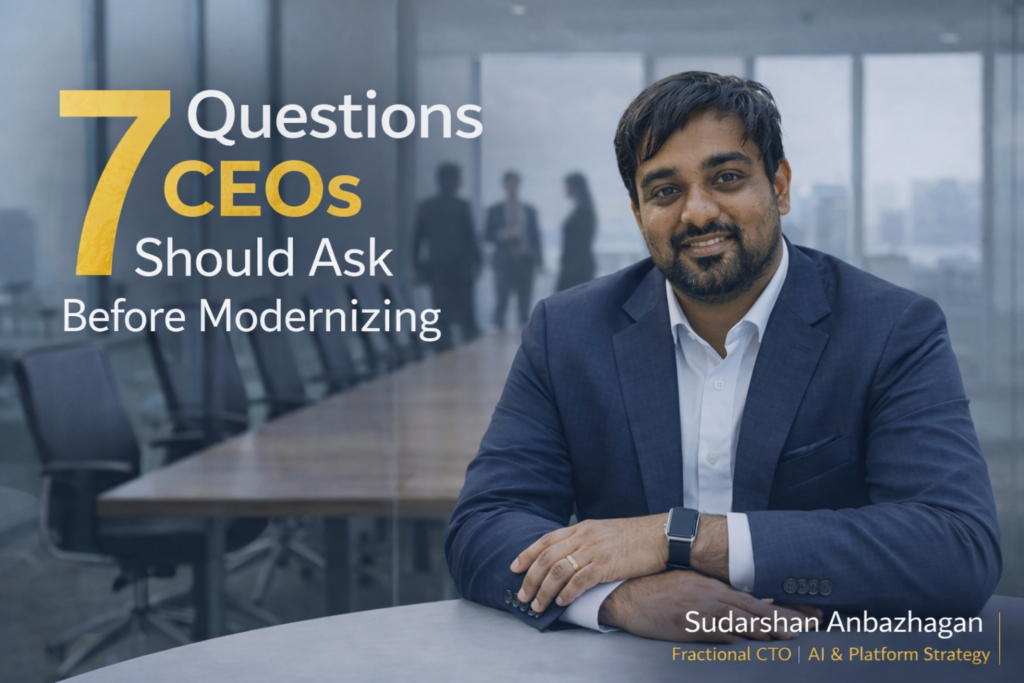

Most modernization projects do not fail because of technology. They fail because the right questions were never asked before the first decision was made, before the first vendor was engaged, and before the first system was touched.
If you are a CEO or enterprise executive currently evaluating a modernization initiative whether it involves core infrastructure, ERP platforms, data architecture, or operational technology, the pressure to move is real and it is intensifying. Boards want visible progress. Competitors appear to be accelerating. Market windows feel shorter than they once did. And yet, the organizations that consistently achieve zero downtime modernization while delivering measurable, durable ROI are rarely the ones who moved the fastest. They are the ones who asked the most disciplined questions before they moved at all. This is not a case for slowing down transformation. It is a case for ensuring that when you move, you move with the precision, alignment, and governance clarity that enterprise-scale modernization genuinely demands. The seven questions in this framework are designed specifically for C-suite leaders who understand that the real cost of getting modernization wrong extends far beyond the immediate financial impact. It touches reputation, culture, customer trust, regulatory standing, and the long-term strategic confidence of the entire organization.
The executives who navigate this well are not those with the largest budgets or the most advanced technology partners. They are the ones who lead the governance conversation with the same rigor they bring to any other major capital decision. And that conversation always begins with the right questions.
Why This Moment Demands a New Level of Executive Discipline
Enterprise modernization is no longer a technology discussion that sits comfortably inside the CTO’s domain. It has become a board-level governance conversation happening in virtually every major organization across the United States, the United Kingdom, and continental Europe. The drivers are converging in ways that make this moment genuinely different from previous waves of enterprise technology change. Legacy infrastructure that was built for a different era of scale and a different set of customer expectations is now creating measurable drag on operational performance. The cost of maintaining systems that were never designed for cloud-native environments, real-time data demands, or AI-ready architectures is rising steadily. At the same time, the competitive pressure to modernize is intensifying, not because modernization is fashionable, but because the organizations that have done it well are beginning to operate at a fundamentally different level of efficiency, responsiveness, and business scalability. For executive leadership teams in financial services, healthcare, manufacturing, logistics, and professional services, the question is no longer whether to modernize. The strategic question is how to modernize in a way that protects the operational foundations the business depends on today while building the capabilities the business will need tomorrow. That tension between continuity and transformation is the defining leadership challenge of this decade.
In the United Kingdom and across Europe, regulatory frameworks such as the Digital Operational Resilience Act are adding a compliance dimension to every modernization initiative that simply did not exist five years ago. Data sovereignty requirements, operational resilience standards, and third-party risk governance obligations are all creating new parameters within which modernization must be planned and executed. For leaders of multinational organizations, navigating these requirements across jurisdictions adds a layer of complexity that demands more governance sophistication, not less.
In the United States, particularly across regulated industries, the tolerance for operational disruption during technology transitions has declined sharply. Customers who experience service interruption during a migration have more alternatives than ever and a lower threshold for switching. Regulators who observe operational incidents during modernization initiatives are increasingly inclined to view them as evidence of inadequate change governance. And internal teams who witness a modernization initiative that causes unexpected downtime or performance degradation carry that experience forward into every subsequent transformation conversation.
This is precisely why zero downtime modernization has become the standard that enterprise leaders must architect for from the beginning, not the aspirational outcome they hope to achieve by the end. The risk management dimension alone justifies a structured, CEO-level review before any major modernization initiative begins. When production systems experience disruption, even briefly, the downstream consequences reach further and last longer than most pre-project assessments account for. The organizations that are managing this well share a common characteristic. They have elevated modernization governance to a strategic discipline, not a project management function. They treat the pre-modernization phase as an investment with its own governance framework, its own success criteria, and its own executive accountability. And they begin that phase with a set of questions that surface the organizational readiness gaps that technology plans alone cannot reveal.
The Executive Framework: 7 Questions That Determine Modernization Success
What follows is a governance framework built from over twelve years of enterprise transformation leadership across fourteen countries and a wide range of industries. These seven questions are not technical audit questions. They are leadership questions. Each one surfaces a different dimension of organizational readiness, strategic alignment, and governance maturity. They are designed to be asked at the CEO or executive committee level, ideally before any vendor selection, architecture decision, or project timeline is committed to.
Question 1: Do we have a clear and agreed definition of success that goes beyond technical outcomes?
- What does success look like from the customer experience perspective, the revenue continuity perspective, and the regulatory compliance perspective?
- Have the CEO, CFO, COO, and CTO aligned on a shared set of business outcome metrics, not just technology delivery milestones?
- Is there a documented baseline of current system performance that will serve as the reference point for measuring improvement?
This is the first and most foundational question in the framework, and it is the one most frequently underinvested in. Many modernization initiatives are launched with technically precise objectives: migrate a defined set of systems, reduce infrastructure costs by a target percentage, decommission a list of legacy platforms. These are outputs. They describe what the technology team will do. They do not describe what the business will gain, protect, or improve as a result.
A disciplined approach to operational excellence in enterprise modernization begins with defining success in terms that every executive function can own. Customer experience continuity means that the end users of your systems will not notice the transition unless they are looking for improvements. Revenue protection during transition means that transaction processing, customer-facing services, and partner integrations will maintain their current performance standards throughout the migration window. Regulatory compliance maintenance means that every obligation the organization carries today will be met without interruption or exception during and after the modernization. If the CEO, COO, and CFO cannot articulate the definition of success in these terms before the project begins, the governance foundation is not yet solid enough to support a safe and productive transformation.
Question 2: Is our risk management framework mature enough for this scale of transition?
- Have rollback plans been tested under realistic conditions, not just documented in a project plan?
- Are incident escalation protocols understood and rehearsed by every team leader who will be involved in the transition?
- Have risk thresholds been defined at the executive level, meaning the specific conditions under which the transition would be paused or reversed?
Risk management in the context of enterprise modernization is not primarily about identifying what could go wrong. Most experienced technology leaders can produce a risk register with reasonable accuracy. The more important question is whether the organization has tested, rehearsed, and governable responses ready before anything goes wrong. This distinction matters enormously at the moment of a live transition, when decision quality under pressure determines whether a minor incident becomes a contained event or a significant operational disruption.
Rollback plans are perhaps the most important risk management tool in a modernization initiative, and they are also the most frequently underinvested. A rollback plan that exists only in documentation is not a rollback plan. It is a recovery intention. The organizations that execute zero downtime modernization with consistency are those where rollback procedures have been rehearsed under realistic load conditions, where the team responsible for executing a rollback has done so in a test environment, and where the triggers for initiating a rollback are defined clearly enough that a team leader in the middle of a migration window does not need to escalate before acting. Incident response protocols must extend beyond the technology team. The operations function, the customer communication function, the regulatory reporting function, and the executive communication function all have roles to play when a significant incident occurs during a live transition. The organizations that manage these moments well are those where every function knows its role before the transition begins, not during it.
Question 3: Do we have genuine cross-functional alignment, or executive sign-off that has been mistaken for alignment?
- Can every functional leader articulate the modernization plan in terms relevant to their own domain?
- Are conflict resolution protocols in place for decisions that will need to be made at the intersection of technology, operations, finance, and compliance?
- Is there a communication cadence during the transition that keeps every function informed without creating decision fatigue?
Cross-functional alignment is one of the most commonly overestimated elements of enterprise modernization readiness. When a CEO asks whether the organization is aligned on a major initiative, the answer is almost always yes. The more revealing question is to ask each functional leader to describe the initiative and their role in it independently. The variation in those descriptions is almost always more significant than the leadership team expects, and that variation is a reliable predictor of the friction points that will emerge during the transition itself.
True cross-functional alignment means that the operations team, the finance function, the compliance team, the customer experience organization, and the technology team all understand the modernization plan, understand the decisions they are authorized to make during critical transition windows, and understand how to escalate when a decision exceeds their authorization. It means that the language used to describe the initiative is consistent across functions, because consistent language reflects consistent understanding. Achieving this level of alignment takes deliberate investment before the modernization begins. It requires facilitated alignment sessions at the functional leadership level, documented decision rights frameworks, and a shared vocabulary for describing the initiative’s objectives, constraints, and success criteria. This investment is not overhead. It is the governance infrastructure that makes zero downtime modernization achievable rather than aspirational.
Question 4: Have we validated our business scalability assumptions in the target architecture?
- Has the target architecture been stress-tested against the growth scenarios in the current business plan, not just against current operational parameters?
- Are the scalability assumptions in the modernization design aligned with the M&A strategy, market expansion plans, or product roadmap?
- Is there a defined process for revisiting scalability assumptions if business conditions change materially during the modernization window?
One of the most consistently damaging patterns in enterprise modernization is designing for current operational scale and then discovering, after the transition is complete, that the new architecture cannot support the growth scenarios that were already embedded in the business plan. This is not a technology failure. It is a governance failure, specifically the failure to ensure that the technology design conversation and the business strategy conversation are happening in the same room at the same time.
Business scalability must be tested against realistic future-state projections that include the full range of growth scenarios the organization is planning for. This is especially critical for organizations that are pursuing market expansion, evaluating acquisition targets, or launching new product lines during the modernization window. The architecture that is right for today’s operational scale may not be the architecture that supports the business three years from now, and the cost of discovering that gap after a major modernization is complete is significantly higher than the cost of closing it before the transition begins.
Question 5: Is our governance framework designed for the pace that modernization actually requires?
- Are decision-making cycles short enough to support real-time choices during live migration windows?
- Are decision rights clearly defined and documented at every level of the modernization governance structure?
- Is there a mechanism for the board or executive committee to maintain visibility into the initiative without creating a bottleneck in day-to-day decision-making?
Modernization initiatives move at a pace that most traditional enterprise governance frameworks were not designed to support. The decision cycles that work effectively for annual strategic planning, quarterly business reviews, or capital allocation committees will create dangerous bottlenecks during a live migration. The governance model for a major modernization initiative must be purpose-built for the pace and the pressure of transformation, while still maintaining the visibility and accountability that executive leadership and the board require.
A well-designed modernization governance framework defines decision authority at every level. Team leads have pre-authorized authority over a defined category of operational decisions. The CTO and COO have authority over a defined category of architectural and business continuity decisions. The CEO has authority over decisions that affect the organization’s external commitments, regulatory standing, or strategic direction. And the board has visibility into the initiative through a rhythm that keeps them informed without pulling them into operational decision-making they are not positioned to support.
This kind of governance clarity does not emerge from a project plan. It requires a deliberate design conversation at the executive level before the modernization begins, and it requires the discipline to maintain that structure even when the pressure to accelerate or simplify creates the temptation to short-circuit the agreed process.
Question 6: Have we defined zero downtime in precise operational terms, not just as a goal?
- Does the organization have a shared, documented definition of what zero downtime means for each system and each user population in scope?
- Are the measurement methods for tracking downtime and performance degradation agreed upon in advance?
- Is the definition of zero downtime written into the project governance, the vendor contracts, and the team-level accountability frameworks?
Zero downtime modernization is a standard, not a slogan. But it only functions as a standard when it is defined with enough precision to be measurable, enforceable, and actionable. The definition will differ by organization and by system, and that is appropriate. What matters is that the definition is explicit, agreed upon at the executive level, and embedded into the governance of the initiative from the outset.
For a customer-facing transaction system, zero downtime may mean that no end user experiences a service interruption of more than a defined number of seconds, and that transaction processing speed remains within a defined tolerance throughout the migration window. For an internal ERP platform, it may mean that all business-critical processes remain available to all authorized users throughout the transition, even if some non-critical functionality is temporarily unavailable. For a data platform, it may mean that reporting and analytics outputs remain accurate and available to all consumers throughout the migration, with no unexplained gaps or degradations in data quality.
Defining these standards in precise operational terms before the modernization begins serves multiple purposes. It creates a shared reference point for the technology team, the operations team, and the executive committee. It creates the basis for holding vendors and implementation partners accountable. And it creates the measurement framework that will allow the organization to confirm, after the transition is complete, that the zero downtime standard was genuinely met.
Question 7: Does the executive team have the genuine leadership bandwidth to govern this initiative alongside running the business?
- Is there protected time in the CEO’s calendar and the executive committee’s rhythm for meaningful engagement with the modernization initiative throughout its lifecycle?
- Is accountability for the initiative’s outcomes assigned to a specific executive, not distributed across a committee or delegated entirely to a project management office?
- Is the organization’s current operational capacity sufficient to support a major transformation initiative without creating unsustainable pressure on the teams responsible for delivering business results?
This is the question that is most often avoided and most often responsible for modernization initiatives that begin well and then drift. The pressure that every executive team operates under is real, and the temptation to launch a major transformation initiative and then delegate its governance to a project management office or a technology steering committee is understandable. It is also one of the most reliable predictors of modernization outcomes that fall short of their potential.
Sustainable executive leadership of a major modernization initiative requires protected time, genuine engagement, and clear personal accountability at the CEO level. This does not mean that the CEO needs to be involved in every architectural decision or every vendor negotiation. It means that the CEO is consistently engaged with the governance of the initiative, consistently receiving the right information at the right level of abstraction, and consistently making the calls that only the CEO can make. When that engagement is present throughout the lifecycle of a modernization initiative, the organization moves faster, not slower, because decisions get made at the right level with the right authority.
Practical Leadership Insights From Enterprise Transformation
The executives who navigate modernization most successfully share a set of disciplines that are worth examining in detail, because they are not intuitive and they are not widely practiced.
The first is the discipline of baselining before changing anything. Before any modernization initiative begins, the organization should have a precisely documented picture of what its current systems are delivering: response times, transaction volumes, error rates, availability metrics, user satisfaction scores, and cost per transaction. This baseline serves as the reference point throughout the transition and as the evidence base for ROI measurement after completion. Organizations that skip this step consistently find themselves in the difficult position of claiming modernization success without the data to demonstrate it.
The second discipline is pre-authorizing decision categories before the transition begins. Many organizations invest heavily in pre-migration planning and then discover that their governance model cannot support the speed of decision-making required during a live migration window. Team leaders who need to escalate routine decisions during a critical transition window create delays that compound quickly. The organizations that execute cleanly are those that have defined in advance which decisions can be made at the team level, which require CTO or COO escalation, and which require CEO notification. This framework eliminates the hesitation that causes the most costly delays.
The third discipline is treating communication as a governance function, not a communications task. During a major modernization initiative, the quality and consistency of internal communication is a direct determinant of organizational performance. Teams that are well-informed make better decisions. Teams that understand the rationale behind the initiative maintain higher engagement throughout a long and demanding transition. And teams that feel trusted and respected by their leadership during a difficult transformation carry that experience forward into the next initiative. The organizations that build enduring capacity for transformation are those where executive communication during change is honest, consistent, and calm.
The fourth discipline is managing the human dimension of technology change with the same rigor applied to the technical dimension. Systems can be migrated. People must be led. The teams responsible for operating modernized systems need preparation, clear expectations, and the psychological safety to raise concerns during the transition without fear of consequence. The modernization initiatives that deliver their full potential are those where every person involved feels genuinely supported throughout the process.
The fifth and perhaps most important discipline is approaching modernization as a capability-building exercise, not just a delivery event. The organizations that develop the greatest long-term advantage from modernization are those that use each initiative to build deeper organizational capability: better governance frameworks, more experienced teams, stronger vendor relationships, and a more refined understanding of how to manage transformation at scale. This perspective shifts the return on modernization investment from the immediate financial metrics to a broader, more durable form of organizational value.
What the Most Effective Executives Do Differently
Across enterprise transformation engagements spanning financial services, manufacturing, healthcare, logistics, and professional services in the US, UK, Europe, and beyond, the executives who achieve consistently strong modernization outcomes share a set of behaviors that distinguish them from those who achieve more modest results.
They engage with the governance framework personally, not just at launch and at conclusion but throughout the initiative. They ask the same quality of questions at the midpoint of a modernization that they ask at the beginning. They do not assume that a well-designed plan will execute itself. They maintain the curiosity and the attention that transformation requires.
They invest in the relationships between functions before and during the modernization, not just in the technology plan. They create deliberate opportunities for the technology, operations, finance, and compliance leaders to build shared understanding and shared trust before the pressure of a live transition tests those relationships. They know that the quality of cross-functional relationships during a migration is as important as the quality of the technical architecture.
They communicate with their teams in a way that creates confidence without creating complacency. They are honest about the challenges of transformation without amplifying anxiety. They celebrate progress at meaningful intervals without losing sight of the distance remaining. And they maintain the calm, composed leadership presence that gives their teams the stability to perform well under pressure.
They also make the strategic growth dimension of modernization explicit. They connect the dots, clearly and repeatedly, between the investment in transformation and the business outcomes it is designed to enable. They make sure that every person involved in the initiative understands not just what they are doing but why it matters for the organization’s future. That connection between individual contribution and strategic purpose is one of the most powerful sources of sustained energy in a long modernization initiative.
A Forward-Looking View for Enterprise Leaders
The organizations that will define enterprise performance over the next decade are those that have developed the capacity to modernize without disruption. Not as a one-time achievement, but as an ongoing organizational capability that grows more refined and more efficient with each initiative. Zero downtime modernization is not simply a technical standard. It is a leadership standard, and the organizations that achieve it consistently are those that have made governance excellence a defining characteristic of how they lead. For executives who are currently evaluating modernization initiatives, the seven questions in this framework offer a starting point for the governance conversation that should precede every major transformation decision. The answers to these questions will surface gaps in organizational readiness, clarify the investments required before the transition begins, and create the conditions for a modernization that delivers on its full promise.
The future belongs to enterprises that can change at pace without losing stability. Organizations that can modernize their core systems, integrate emerging technologies, expand into new markets, and scale their operations without putting at risk the operational foundations that their customers, their people, and their stakeholders depend on. These organizations are not defined primarily by their technology. They are defined by the quality of their leadership, the discipline of their governance, and the clarity and courage of the questions they ask before they act. The question is not whether to modernize. The question is whether you are asking the right questions before you do. And for the organizations that get this right, the competitive distance they create is one that becomes increasingly difficult for others to close.