
Why AI Will Not Fix a Company That Has Not Fixed Its Processes First
Every AI rollout conversation I sit in eventually reaches the same unspoken assumption. Leadership believes that if a process is slow today, wrapping it in automation will make it fast tomorrow. That assumption is understandable and it is almost always wrong. AI does not fix a broken process. It photographs that process at a much higher speed, and hands leadership a cleaner looking report about the same bad outcome.
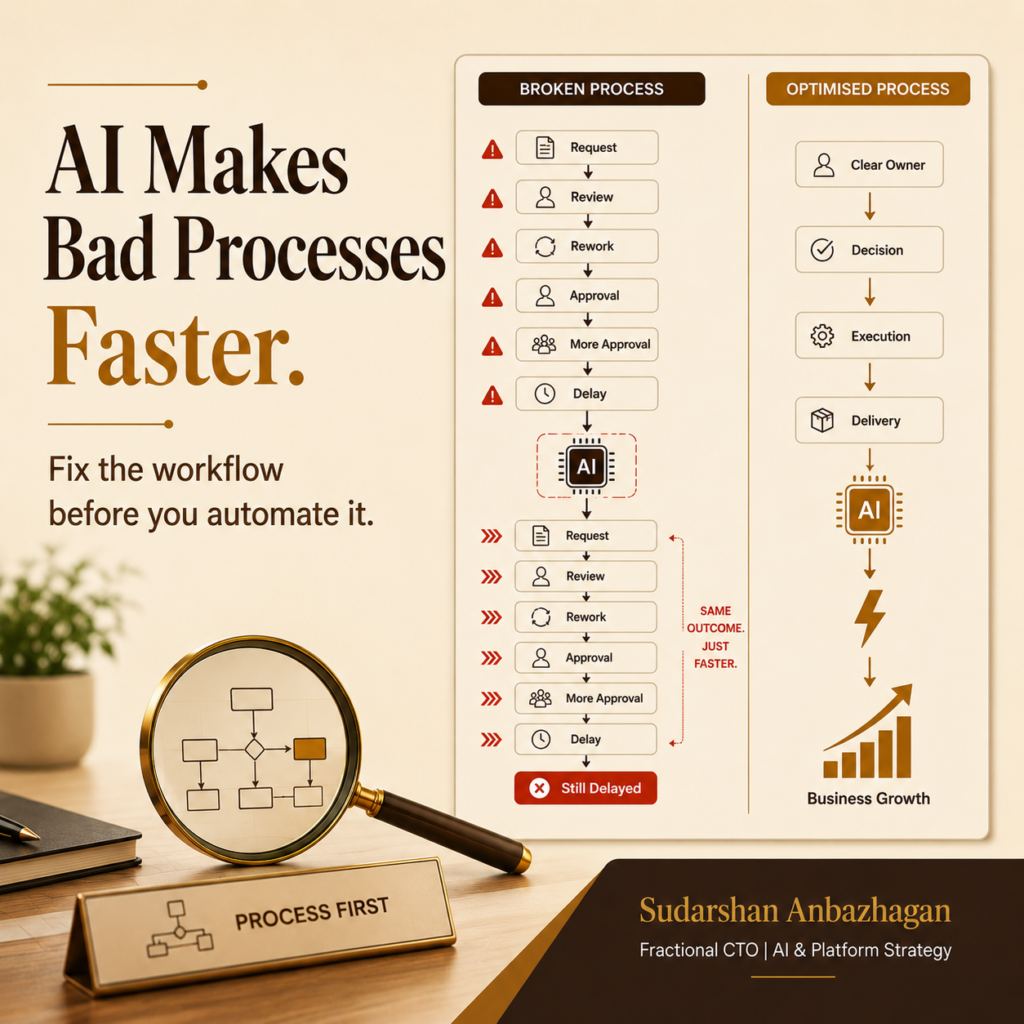
An approval chain with four unnecessary sign offs does not become a two sign off process because a model now drafts the request faster. It becomes a four sign off process that arrives in everyone’s inbox sooner, which simply means the bottleneck shows up faster without disappearing. This is the uncomfortable truth few vendors mention mid pitch, and it is the single most consistent lesson across the technology engagements I have led.
Before any serious AI conversation goes further in an engagement, I ask one question that tends to reframe the entire discussion: if we removed the tool completely, would this process still make sense on its own? Most of the time, the honest answer is no, and that gap is the real project. Not the AI rollout everyone in the room is excited about.
Why AI Will Not Fix a Company Still Running on Broken Workflows
Process design and AI adoption sit in a specific order that most transformation roadmaps get backwards. Leadership tends to sequence it as pilot the tool, prove the value, then worry about process later if something feels off. The order that actually compounds is the reverse. Fix the workflow first, then apply automation to a process that already makes sense on its own.
The reason this order matters so much is that AI is extremely good at doing exactly what it is told, at a scale and speed no manual process could match. That is precisely what makes a flawed process dangerous once it is automated. A single unclear escalation rule that used to cause a day of friction now causes the same friction across a hundred cases simultaneously, because the tool executes the instruction faithfully rather than questioning whether the instruction was ever sound.
The Process Audit Nobody Wants to Run Before the AI Pilot
Across the AI and platform engagements I have advised, the companies that get real return on investment share one habit that has nothing to do with model selection or infrastructure choice. They run an honest process audit before automating anything, and they are willing to hear that the answer to the audit is often uncomfortable.
An inefficient approval chain, sped up by AI, is still an inefficient approval chain. It simply produces the same bad outcome faster, with a cleaner report attached.
| Question | What It Reveals | Common Answer |
|---|---|---|
| Does this step exist because it is needed, or because it always has | Legacy steps nobody has re-examined in years | Usually the latter |
| Would removing the tool break the process | Whether the workflow has real logic underneath it | Frequently, no logic remains |
| Who actually owns the decision at each step | Whether accountability or habit is driving the workflow | Often nobody can answer cleanly |
Running these three questions against any existing workflow before automating it takes an afternoon. Skipping the audit and automating anyway means discovering the same three answers months later, after the flawed process has already been running at machine speed and scale.
The Process First Sequencing Model
I use a structure I call the Process First Sequencing Model in nearly every AI advisory engagement, and it has proven more predictive of AI project success than any technical evaluation criteria I have used before it.
- Stage one, Strip the process to its logic. Remove every step and ask whether it survives the question of why it exists, before any tool touches the workflow.
- Stage two, Assign clear ownership. Every remaining step needs one named owner accountable for the decision it represents, not a shared responsibility that dilutes into no responsibility.
- Stage three, Automate what survives. Only once a process is stripped to its real logic and ownership is explicit does automation actually compound value, because there is nothing left to hide inefficiency.
Companies that follow this sequence rarely need a second, corrective transformation project eighteen months later to undo what the first rollout automated by mistake. Fixing the process first is slower to announce in a board deck and far less exciting than an AI pilot demo, but it is the only version of transformation that actually compounds instead of simply accelerating existing dysfunction.
What Leadership Needs to Understand Before Approving the Budget
Non technical leadership does not need to understand the model architecture behind an AI initiative. What they need to understand is a much simpler distinction: every AI investment is really a bet on the process underneath it, wearing a technical name. Once a leadership team starts asking what decision an AI tool is protecting rather than how the tool technically works, the entire budget conversation gets easier and considerably more honest.
I have sat across the table from leadership teams who approved significant automation budgets without ever asking whether the underlying workflow made sense. Six months later, the honest question in the room was never about the tool’s performance. It was why the same bottleneck still existed, just faster and with a better looking dashboard sitting on top of it. That pattern is avoidable, and avoiding it starts with a single willingness to look at the process before looking at the technology.
Building AI Adoption That Actually Compounds
The technology leaders who get the most durable return from AI adoption are rarely the ones who moved fastest into a pilot. They are the ones who accepted, early, that the unglamorous process work had to happen first, even when it meant delaying a demo that leadership was eager to show off. That patience is difficult to sustain inside an organisation under pressure to demonstrate AI progress quickly, which is exactly why so few companies actually do it, and why the ones that do tend to pull ahead of competitors still automating dysfunction at speed.
If your organisation is weighing its next AI investment, the more valuable exercise is not evaluating vendors. It is running the process audit honestly enough to hear an uncomfortable answer, and being willing to fix the workflow before a single line of automation touches it. Have you fixed the process, or have you simply made the broken one faster and better documented?
The Leadership Conversation This Requires
Recommending a delay to an AI rollout is one of the harder conversations a technology leader has with an executive team, because it runs directly against the momentum everyone wants to feel. Boards ask about AI progress. Competitors announce pilots. Internal teams want visible movement. Standing in front of that pressure and saying the honest next step is a process audit, not a demo, takes a kind of credibility that is earned rather than assumed.
The leaders who can hold that line successfully are usually the ones who have already built enough trust with the executive team to be believed when they say slower now means faster later. That trust rarely exists on day one of an engagement. It gets built through smaller decisions made correctly first, so that when the harder recommendation arrives, the leadership team already has a reason to listen rather than to push back out of frustration with the delay.
This is also where a fractional or dedicated technology leader earns their place in the room rather than simply executing what leadership already decided. Anyone can approve a vendor contract. Far fewer people are positioned, or willing, to tell an executive team that the excitement around a specific tool is outpacing the readiness of the process it is meant to support. That willingness, more than any technical expertise, is what actually protects the return on an AI investment before the money is spent rather than after.
What Changes Once the Process Is Fixed First
Companies that do the unglamorous process work before automating report a different kind of outcome six months later. The AI tool becomes almost invisible in conversation, because it is simply working the way it was expected to from the start. There is no follow up meeting explaining why the automation did not deliver what the pitch promised, because the workflow underneath it was already sound before the tool touched it.
That invisibility is, counterintuitively, the actual sign of success. The rollouts that generate the most conversation after launch are usually the ones where something needed fixing that should have been fixed first. Silence, in this context, is the clearest evidence that the sequencing was right, and it is the outcome every leadership team should actually be optimising for, even though it rarely photographs as well in a board presentation as a live demo does.