
What AI Adoption Looks Like When Leadership Is Truly Ready for It
I have walked into organisations with cutting-edge AI infrastructure and watched them produce nothing of consequence. Sophisticated model deployments. Clean data pipelines. A dedicated AI function with genuine talent. And at the end of the quarter, no measurable change in any business outcome that leadership actually cared about. I have also watched a mid-sized team with a modest stack redesign their core operations in under six months using AI. The difference was not technology. It was leadership posture.
Leadership-ready AI adoption is one of those concepts that sounds self-evident until you try to operationalise it. Every leadership team believes they are ready. The question is not readiness as a feeling, it is readiness as a structural condition. And the structural conditions that determine whether AI investments compound or simply cost money are specific, assessable, and largely independent of which AI technology a company chooses to deploy.
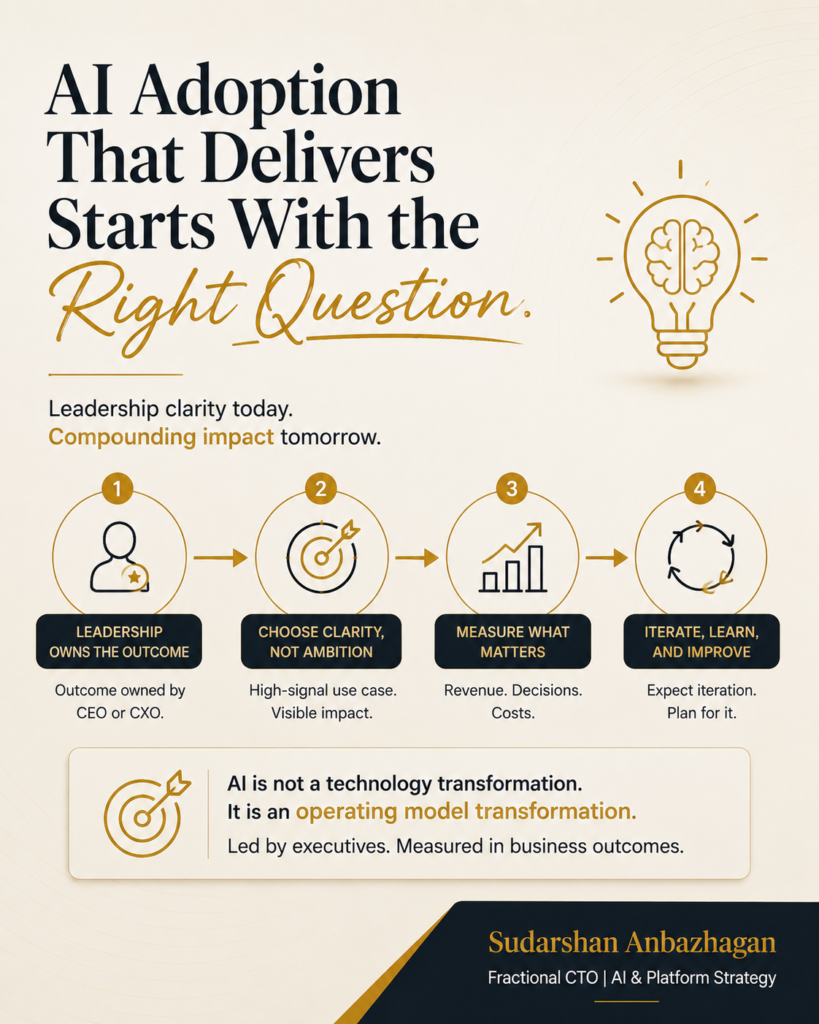
AI is not a technology transformation. It is an operating model transformation that happens to use technology. And operating model transformations are led by executives, not implemented by vendors.
The Question Most Teams Never Ask
Leadership-ready AI adoption starts with a question most teams never ask: what decision do we need to make faster, and what would change in this business if we could? That question forces specificity in a way that most AI strategy conversations avoid. It names a decision. It names an outcome. It creates a concrete connection between the AI capability and the business impact, which is the connection that makes AI investments legible to finance, measurable to operations, and accountable to leadership.
Most AI strategy conversations start differently. They start with technology exploration: what AI capabilities exist, what our competitors are doing with AI, what our data architecture can support. These are legitimate questions, but they are second-order questions. They describe what is possible. They do not describe what would be valuable, and in the absence of that distinction, organisations invest in AI capabilities that are technically impressive and strategically disconnected.
The specificity question, which decision, which outcome, by how much, by when, is what separates AI investments that compound from ones that just cost money. It is also, in my experience at SuperBotics MultiTech, the question that most consistently predicts whether a first AI deployment will create the organisational momentum needed to sustain a multi-year AI programme, or whether it will produce a proof of concept that quietly disappears after the initial excitement fades.
What I Consistently See in Organisations Where AI Actually Delivers
Leadership owns the outcome, not just the budget line. In every AI engagement that has produced durable business value, the CEO or CXO is directly accountable for the first use case. Not the IT function. Not an AI committee. Not the transformation office. The person whose performance evaluation includes the outcome that AI is meant to improve is the person who owns the AI deployment. That accountability creates the decision-making authority required to clear the organisational friction that every AI deployment encounters, and that friction is always real, regardless of how technically straightforward the implementation appears.
The first deployment is chosen for clarity, not ambition. The organisations that succeed with AI consistently choose their first deployment based on three criteria: high signal in the output, low complexity in the implementation, and a visible outcome that business leadership can evaluate without technical expertise. One thing done well before ten things done poorly. This is not a permanent constraint, it is a foundation-building strategy. The first deployment creates the organisational proof point that makes subsequent deployments faster, better resourced, and more effectively integrated into business processes.
| AI Deployment Approach | First Outcome Timeline | Sustainability |
|———————–|———————-|—————-|
| Leadership-owned, outcome-specific | 60-90 days | High, compounding value |
| IT-led, technology-driven | 6-12 months | Low, disconnected from business |
| Committee-governed, risk-averse | 12-18 months | Medium, slow but stable |
| Vendor-implemented, output-focused | Variable | Low, vendor dependency |
Success is measured in business terms from day one. Revenue protected. Decisions accelerated. Costs eliminated. Not adoption rate. Not model accuracy. Not the number of API calls. These technical metrics have their place in the implementation process, they are useful for the engineering team managing the deployment. But they are not the metrics that determine whether AI is creating business value, and organisations that report AI performance to leadership in technical terms are implicitly accepting that the business impact will remain unmeasured and therefore unmanaged.
Iteration is expected and resourced. The first version is never the winning version. This is not a statement about the quality of the initial implementation, it is a statement about the nature of learning. Every AI deployment reveals information about the business process it is embedded in, the data quality it depends on, and the decision patterns of the humans who interact with it. That information makes the second version better. Organisations that plan for iteration, that resource the second and third version before the first one goes live, consistently outperform the ones that expect perfection from the initial deployment and interpret the need for iteration as a sign of failure.
The Operating Model Transformation Frame
The framing that I find most consistently useful with leadership teams navigating AI strategy is this: AI is not a technology transformation. It is an operating model transformation that happens to use technology. That reframe has practical implications for how the programme is governed, how success is measured, and who owns accountability for outcomes.
An operating model transformation requires leadership sponsorship, not IT project management. It requires business outcome metrics, not technical performance dashboards. It requires change management investment, not just implementation investment. And it requires a sustained commitment to iteration and learning, not a one-time deployment event followed by a maintenance posture.
Organisations that approach AI as a technology transformation tend to delegate it to the technology function, measure it with technology metrics, and wonder why the business impact does not materialise. Organisations that approach it as an operating model transformation keep it at the leadership table, measure it with business metrics, and create the structural conditions for AI investments to compound over time. The technology is the same. The organisational approach is what determines the outcome.
The Question That Tells You Everything About Readiness
The single most reliable readiness diagnostic I have found is this: if your AI pilot worked exactly as promised, what business outcome changes by how much, by when? If leadership can answer that question with a number and a date, the organisation has the strategic clarity required for AI to deliver value. If the answer defaults to descriptions of the AI capability itself, or to vague statements about efficiency improvement, the technology is ahead of the strategy.
That diagnostic question is also the foundation for the measurement framework that makes AI programmes accountable. When the outcome is specific and time-bound, progress can be tracked, adjustments can be made, and success can be defined in terms that the full leadership team, not just the technology function, can evaluate. That shared evaluative framework is what keeps AI programmes on the leadership agenda through the inevitable periods of slower progress, and what creates the organisational appetite to expand AI investment when the first use case delivers.
The relationship between AI strategy and long-term technology leadership credibility is explored in the companion piece on what builds trust in a technology leader over timethe same accountability orientation that produces durable leadership trust also drives sustainable AI value creation.