
In today’s enterprise environment, operational excellence is no longer defined by the quality of individual tools or platforms considered in isolation. It is defined by how effectively those tools connect, communicate, and collectively support the organization’s strategic direction. For senior leaders responsible for setting operational direction at the enterprise level, workflow integration has quietly become one of the most consequential governance responsibilities on the executive agenda.
This is not a technology conversation. It is a leadership conversation. Organizations that recognize that distinction are the ones building the operational foundations required for scalable, resilient, and long-term growth. They are the ones whose teams coordinate with fluency, whose decisions are grounded in reliable data, and whose workflows absorb change without losing coherence. In short, they are the organizations that compete from a position of operational strength rather than operational friction.
The purpose of this article is to offer a structured, executive-level perspective on what it takes to lead workflow integration as a governance discipline, why it matters at the strategic level, and how senior leaders across industries can build the frameworks that sustain enterprise performance over time.
The Business Context: Why Integration Has Become a Strategic Priority
For much of the past two decades, enterprise investment focused heavily on acquiring capability. Organizations expanded their technology portfolios with genuine intent: to improve efficiency, increase visibility, and accelerate performance. New platforms were adopted. Digital infrastructure was built. Systems were introduced with the expectation that they would deliver measurable operational improvement. Many organizations succeeded in adding capability. Fewer succeeded in integrating it. The result, across industries and geographies, is a common operational challenge: organizations operating with strong individual systems that do not communicate with the fluency or consistency that enterprise performance demands. Workflows fragment across functions. Accountability gaps emerge at the boundaries between teams and platforms. Decision-making slows because the data required to act with confidence sits in disconnected corners of the business rather than flowing clearly to the people who need it.
This is the integration deficit, and it carries meaningful costs. It shows up as duplicated effort, inconsistent reporting, delayed escalations, and a persistent friction that quietly reduces the organization’s operational velocity. For executives managing complex, multi-function enterprises across multiple geographies, that friction compounds over time. It affects not only efficiency but strategic agility, which is the organization’s capacity to respond to change with speed, confidence, and coordination. Closing that deficit requires more than a technical refresh. It requires operational governance: a structured, leadership-driven commitment to ensuring that systems, processes, and accountability are aligned across the enterprise and maintained with consistency. Organizations that invest in this governance commitment find that integration moves from a recurring challenge to a sustainable capability. That shift is both an operational and a strategic achievement.
What Operational Governance Really Means at the Executive Level
Governance, in the operational context, is the framework through which leaders ensure that the enterprise functions as a coherent whole rather than a collection of independent parts. It is the discipline of establishing clear ownership, maintaining standards, creating visibility, and building the conditions for continuous improvement across every function of the organization. When workflow integration is approached as a governance responsibility rather than a one-time implementation project, it produces a fundamentally different outcome. Integration becomes a sustained operational capability rather than a project milestone that fades as teams move on to other priorities. Systems remain aligned over time. Teams maintain shared visibility into how work moves across the enterprise. Leadership retains the confidence to make informed decisions, even as the business evolves, expands, or faces new pressures.
This distinction matters enormously at the executive level. Strategic growth, business scalability, and cross-functional alignment are not outcomes that emerge from a single successful deployment. They are outcomes of consistent, disciplined operations leadership: of organizations that have built governance frameworks strong enough to hold their workflows together under the pressures of growth, change, and increasing complexity. For the CEO, COO, and CFO, investing in that governance capacity is one of the most valuable contributions to long-term enterprise performance. It is also worth noting that governance-led integration creates a more positive organizational experience for the people who work within it. When workflows are clear, when ownership is defined, and when systems operate in alignment, teams spend less time navigating ambiguity and more time contributing to outcomes that matter. That clarity supports morale, reduces operational frustration, and creates the kind of working environment in which talented people are most effective.
A Six-Discipline Framework for Workflow Integration Governance
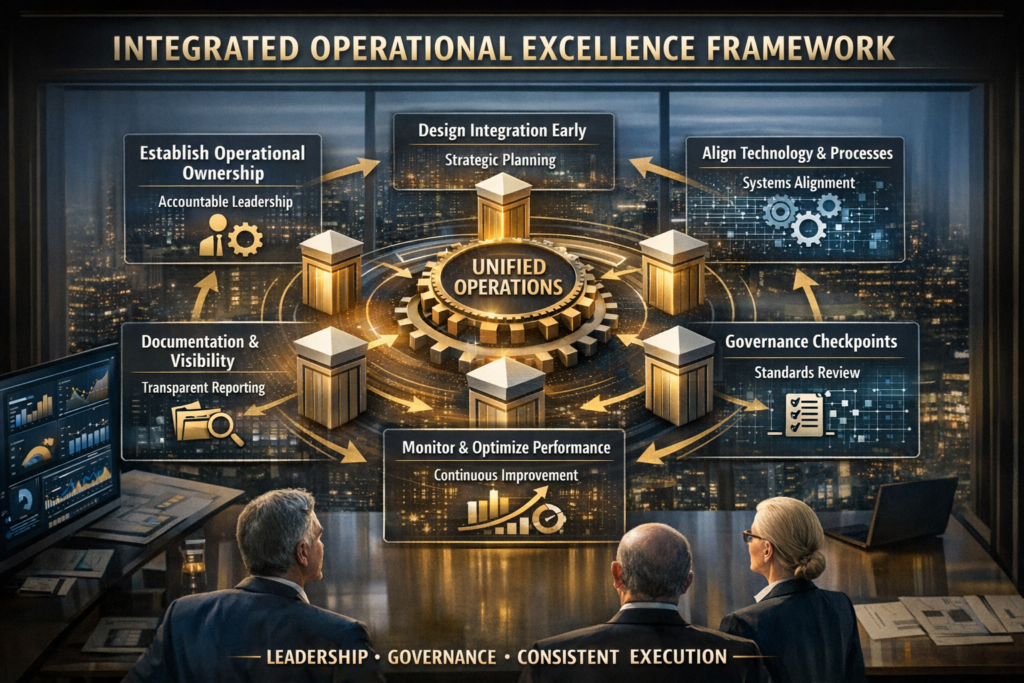
The following six disciplines represent a structured framework for achieving and sustaining workflow integration across the enterprise. They are not sequential steps to be completed and filed away. They are ongoing governance commitments that, practiced together, sustain operational cohesion and enterprise performance over time.
1. Establish Clear Operational Ownership
Sustainable workflow integration begins with accountability. Every integrated workflow, regardless of its scope or complexity, benefits from a clearly defined owner: a senior leader or operations professional with both the authority and the responsibility to ensure that the workflow remains aligned with enterprise priorities. Without defined ownership, integration challenges tend to drift. Issues surface without clear resolution paths. Alignment decisions are delayed while teams seek clarity on who has the authority to act. Over time, small misalignments accumulate into operational friction that is far more difficult to address than it would have been at the outset.
Operational ownership does not mean micromanagement. It means accountability, which is the organizational clarity that ensures someone is consistently attending to the health, alignment, and performance of each critical workflow. In practice, effective ownership looks like this:
- Each major workflow or integration point has a named accountable leader with defined scope and authority.
- That leader maintains regular oversight of performance metrics and alignment with enterprise standards.
- Clear escalation paths exist so that emerging issues are visible to the right decision-makers quickly and without friction.
- Ownership is reviewed periodically to ensure it reflects the current structure of the organization and its priorities.
For enterprise leaders, establishing that clarity is one of the highest-value governance actions available. It creates the organizational conditions in which integration challenges are addressed proactively rather than reactively, and in which accountability is a shared operational value rather than an afterthought.
2. Design Integration Architecture Early
The most durable integrations are those that were considered from the beginning of the planning process, not added as an afterthought once individual systems were already in place. When integration architecture is part of the original operational design, it reflects the actual flow of the business: how data moves, how decisions are made, and how teams hand off work and information to each other. The result is an architecture that supports operational reality rather than one that requires the organization to work around its limitations.
Retrofitting integration into a pre-existing system architecture is possible, but it is consistently more complex, more costly, and more disruptive than building with integration in mind from the start. For organizations planning significant operational investments, whether in new platforms, restructured processes, or expanded business functions, the integration question deserves a prominent place in the early design conversation.
This is particularly true in enterprise environments where multiple functions, geographies, or business units must ultimately share information and accountability. The architectural decisions made at the planning stage shape the organization’s integration capability for years to come. Leaders who invest appropriate attention at this stage protect long-term system stability, reduce the operational burden of future integration work, and build a foundation that scales with the business rather than constraining it.
3. Align Technology with Operational Processes
One of the most consistent findings in enterprise operations is that technology delivers greater value when it is configured to support how the organization actually works, rather than when the organization is asked to adapt its workflows to the constraints of the technology. This principle sounds straightforward, but in practice it requires deliberate and sustained leadership attention.
The instinct to adopt new systems and trust that processes will adapt naturally is understandable. Technology vendors present their platforms compellingly. The pressure to modernize is real and, in many cases, well-founded. But systems introduced without careful alignment to existing operational processes tend to create new complexities even as they resolve old ones. Teams find themselves working with tools that do not match their actual responsibilities, generating friction rather than efficiency.
Effective operations leadership ensures that technology adoption is accompanied by a clear, honest assessment of how the system will interact with current workflows, where gaps or tensions may emerge, and what process adjustments are needed to realize the system’s full value. The questions worth asking at this stage include:
- Does this system support the way our teams actually make decisions and move work forward?
- Where do our current processes need to evolve to align with this platform, and how will we manage that transition?
- Are there integration points between this system and our existing infrastructure that require deliberate architectural attention?
- How will we measure whether the system is delivering the operational value we expect from it?
This alignment work is what allows enterprise performance to improve sustainably, rather than cycling through recurring waves of implementation and recalibration. It reflects a mature, strategic approach to technology investment that serves the organization’s long-term interests rather than its short-term enthusiasm for new capability.
4. Introduce Governance Checkpoints
Integration is not a static achievement. The business environment changes. Systems are updated. Teams evolve. Priorities shift in response to market conditions, organizational restructuring, or strategic realignment. Without structured points of review, even well-designed integrations can gradually drift out of alignment with the enterprise’s current needs and standards. The discipline of governance checkpoints ensures that drift is identified early and addressed before it accumulates into meaningful operational disruption.
Governance checkpoints are periodic, structured reviews of integration health and alignment. They provide the mechanism through which leadership maintains operational cohesion over time. These reviews need not be burdensome. What they require is intention: a regular commitment to examining whether integrations are performing as expected, whether they remain aligned with enterprise governance standards, and whether any adjustments are warranted given changes in the operating environment.
For senior leaders, governance checkpoints also serve an important risk management function. They provide early visibility into misalignments before those misalignments grow into significant operational or compliance issues. In a complex enterprise spanning multiple functions and geographies, that early visibility is a meaningful safeguard. It supports both operational continuity and the organization’s broader risk management posture, giving leadership the confidence that the business is operating within the boundaries it has established for itself.
5. Maintain Documentation and Operational Visibility
Operational transparency is one of the quieter foundations of enterprise performance, and it is consistently underinvested relative to its strategic value. When teams have clear, accurate documentation of how integrated workflows function, including what systems are involved, what handoffs occur, what standards apply, and who holds accountability, coordination improves naturally. Decision-making accelerates because the context required to act with confidence is readily available rather than locked in the institutional knowledge of specific individuals.
Documentation is often deprioritized in fast-moving organizations because its value is diffuse and its absence is not immediately visible. The cost of poor documentation typically becomes apparent in moments of change: when a key team member transitions to a new role, when a system is updated and integration points need to be mapped anew, when a workflow needs to be restructured under time pressure, or when an issue arises that requires rapid root-cause analysis. In each of these moments, strong documentation is the difference between a smooth response and a disruptive one.
Real-time visibility adds another dimension to this principle. When leaders have access to timely, accurate operational data, they are equipped to act on what is actually happening in the business rather than on lagging indicators or incomplete reports. This is the foundation of informed decision-making at the executive level, and it is what separates leaders who respond to events from leaders who anticipate them. Investing in visibility is, in operational terms, an investment in leadership capability and strategic confidence.
6. Monitor Performance and Refine Continuously
The most enduring operational frameworks are those built to evolve. Performance monitoring, structured, consistent, and connected to clear operational standards, provides the feedback loops through which organizations identify opportunities for improvement and act on them before they become constraints. It reflects a mature understanding of how enterprise performance actually develops: not in a single transformation initiative, but through the accumulation of informed, incremental refinements, each one grounded in real data and each one moving the organization closer to its operational potential.
For operations leaders, building a culture of continuous performance review is as important as establishing the monitoring infrastructure itself. When teams understand that performance data is used constructively, to learn, to improve, and to refine rather than to assign blame, they engage with that data more openly and more productively. The result is an organization that improves not just in response to problems but consistently and by design. This is the organizational posture that supports sustained competitive advantage, because it means the enterprise is always moving forward, always finding better ways to serve its customers, its teams, and its strategic objectives.
Integration as the Foundation for Scalable Enterprise Growth
Taken together, these six disciplines describe something more than a workflow management approach. They describe an organizational posture: a way of approaching operations leadership that treats integration as strategic infrastructure rather than as a technical concern to be managed at the systems level and periodically revisited.
This posture carries meaningful implications for business scalability. Organizations that have built strong integration governance are better positioned to absorb growth, add new functions, enter new markets, and respond to structural change without losing operational coherence. The discipline that holds existing workflows together is precisely the same discipline that enables the organization to expand with confidence. Growth does not introduce chaos into a well-governed enterprise. It introduces opportunity, because the operational infrastructure is ready to support it.
It also carries implications for cross-functional alignment, which is one of the most consistently cited challenges in complex organizations. When workflows are integrated under clear governance, functions that depend on each other operate with greater shared visibility and mutual accountability. The coordination costs that typically arise at functional boundaries are reduced. Leaders at every level have clearer sight lines into the operational whole, which means better decisions, faster resolution of operational issues, and a greater sense of shared momentum across the enterprise.
For the most senior leaders, the implications are equally direct. The quality and reliability of what a CEO, COO, or CFO sees when reviewing enterprise performance depends directly on how well the organization’s workflows are integrated and governed. Strategic decisions made on integrated, well-governed operational data are grounded in organizational reality. They reflect what is actually happening across the business, not what individual functions report in isolation. That grounding is invaluable at the level where consequential decisions are made.
The Cultural Dimension of Operational Governance
Governance frameworks are only as effective as the leadership commitment behind them. The six disciplines described in this article require consistent attention, not heroic effort, but steady and sustained engagement from leaders who understand that operational discipline is a competitive advantage and a source of organizational confidence rather than an administrative obligation.
Organizations that have embedded workflow integration governance into their operational culture consistently report a common and encouraging outcome: over time, the work becomes less about managing problems and more about sustaining and expanding capability. Integration that is well-governed rarely requires emergency intervention. It performs consistently and reliably, in alignment with what the enterprise needs to grow. The governance investment, made steadily and with intention, returns compounding value.
There is also a human element to this outcome that deserves acknowledgment. When operations are governed with clarity and purpose, the people working within them experience that clarity positively. They understand their roles and their responsibilities. They have the information and the tools they need to contribute effectively. They trust that the systems they rely on are aligned and maintained. That trust is a meaningful organizational asset, and it is one that strong operations leadership actively cultivates.
Conclusion: Leading with Operational Confidence
The competitive landscape facing senior executives today rewards organizations that can execute with both agility and precision, that can grow without fragmenting, that can adapt without losing alignment, and that can respond to change from a position of operational strength. Workflow integration, governed with discipline and sustained with leadership attention, is one of the foundational capabilities that makes that level of performance possible.
For C-suite executives and senior operations leaders in the United States, Europe, and beyond, the implication is clear. Integration governance is not a concern to be delegated and periodically revisited. It is a strategic leadership responsibility, and one that shapes enterprise performance, supports risk management, enables cross-functional alignment, and creates the operational conditions in which sustainable growth becomes not just possible but consistently achievable.
The six disciplines outlined in this article provide a practical, executive-level framework for approaching that responsibility with structure, intention, and confidence. Organizations that invest in these disciplines are not simply improving their workflows. They are building the operational infrastructure that will support their next stage of strategic growth, and the stage after that, and every stage that follows.
Operational excellence, at its best, is not a destination to be reached and declared complete. It is the disciplined, ongoing work of ensuring that the enterprise is always well-positioned to perform, to adapt, and to lead. That work is the work of great operations leadership, and it is among the most valuable contributions that senior leaders make to the long-term strength and vitality of the organizations they serve.